Run Every Scenario.
See How Your Network Reacts
— Before It Does.
Scenario-based planning for complex logistics networks. Model any decision in isolation, plant shutdown, relay rebalancing, peak surge, DC redesign — and quantify the financial impact before anything goes live.

Validated with BRT, Buzzi Unicem, De Heus & more
Run every scenario. See how your network reacts, before it does.
Scenario-based planning for complex logistics networks.
Model any decision in isolation — plant shutdown, relay rebalancing, peak surge, DC redesign — and quantify the financial impact before anything goes live.

Turn Network Complexity Into a Structural Cost Advantage
Three outcomes your leadership team will recognize on the first read.
Cut transport cost 3–8% before you commit a plan.
Put a number on every alternative and move from a planner’s opinion to a defensible business case — quantified before anything goes live.
week back
Run in minutes what used to take days in Excel, with every scenario compared side by side and the analysis still relevant when the decision lands.
Trade reactive firefighting for sandbox-tested changes — so live operations are never exposed to a decision you haven’t proven.
Built for Complex Network Operations
The same engine, configured to the decision in front of you.
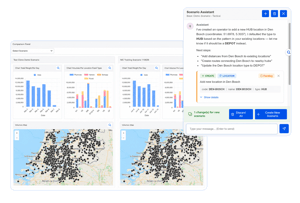
A plant breaks down. A customer needs relocating. You have 48 hours.
Model customer reallocations at the best combined logistics and production cost. See how the network reacts before you commit.
Validated with Buzzi Unicem
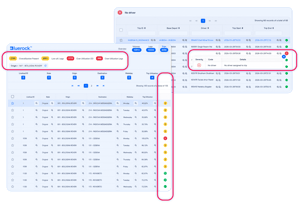
1,772 underloaded legs. 2,705 capacity breaches. Same week.
Spot over- and under-utilized trips in one view. Optimize, simulate reassignments, and publish a balanced weekly plan.
Validated with BRT
Christmas is eight weeks away. Your live plan can’t be touched.
Clone your live scenario, model a +40% spike, find where it breaks, and build a peak plan your team can execute.
Consolidate two DCs or add a third? Model it before you commit.
Test footprint changes, carrier allocation, and service-level trade-offs against live demand — in days, not months.
Road, rail, and sea, synchronized in one environment.
Capture operational rules, loading sequences, and terminal constraints as structured data — not tribal knowledge.
600 trucks. 3,000 deliveries. No two feed types can touch.
Contamination rules built into the system. Assign compartments, validate sequences, and resolve mismatches automatically.
Validated with De Heus
Everything in one planning environment
THE PLATFORM
Most tools stop at the optimization run. Bluerock turns the model into a committed plan your operation can actually execute — connecting strategic, tactical, and daily decisions in one continuous workflow.
Plan With Confidence:
Isolated scenario management
Scenario cloning & version control
Multi-scenario side-by-side comparison
Templated data for import & export
Optimize & Evaluate:
Network & route optimization engine
Automated constraint evaluation
Inline problem detection & severity badges
High-fidelity constraint modeling
Work the Way Your Team Works:
Dual-pane planning workspace
Gantt timeline & map visualization
Multi-user collaboration with record locking
Plan-to-execution handoff into your TMS
From Data Snapshot
to Optimal Plan, Committed
Every Decision Starts in a sandbox
Build a scenario from your live data, stress-test it, compare alternatives side by side, and commit when you’re ready — with one-click revert to any prior version, so your live network is never exposed to a decision you haven’t proven.

Demand and Schedules, Joined in One View
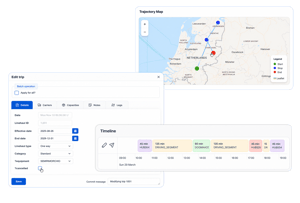
Built around how planners actually think. Volumes on one side, vehicle schedules on the other, joined by a single filter bar. Drag, assign, adjust — and resolve conflicts before the route is published.
Problems Flagged at Planning Time
Every change is checked against your constraints the moment you make it — wrong temperature zone for a compartment, a shift that breaks HOS rules, a leg with no route connection — flagged inline before a truck ever leaves the yard.

Detection Tells You What’s Wrong. The Engine Tells You What’s Best
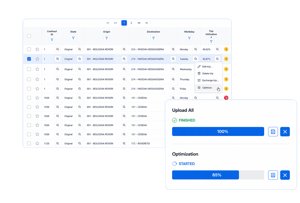
Run network and route optimization across the full scenario, then see the cost and utilization impact quantified against your current plan — so the recommendation always arrives with the business case attached.

“I’ve seen many network tools in my career, but seldom one as flexible and fast as the Network Orchestration tool of Bluerock TMS.”

“With the Network Orchestration tool from Bluerock TMS, we can run many scenarios in very little time and quickly understand how the network reacts.”



Built for complex network, not every network
Is it right for you?
BUILT FOR
✔️ Multi-site manufacturers & retailers with their own distribution
✔️ Complex networks needing structural weekly balancing
✔️ Cross-border or multi-business-unit flows
✔️ Teams that want repeatable, "snapshot" planning
NOT THE RIGHT FIT
✖️ Pure spot-market transport buyers
✖️ Simple point-to-point networks
✖️ Single-warehouse shippers
✖️ One-off, one-time scenario studies
Related Resources
The Hidden Cost of Running Logistics on Five Different Systems
Your TMS Wasn't Built for This. Here's What Breaks First.
Explore Bluerock TMS Depot Flow App
Behind the scenes with our customers
Don’t Just Plan. Orchestrate.
We start by understanding your network: your cost drivers, your constraints, your planning reality, then show you Network Orchestration performing against scenarios that reflect your world, not a generic one.
FAQs
Network Orchestration is the process of modeling, evaluating, and optimizing logistics networks before operational changes are implemented. It allows planners to simulate scenarios such as plant shutdowns, demand surges, customer reallocations, distribution center changes, and transport network redesigns, then quantify the cost, utilization, and service impact before making a decision.
Bluerock TMS identifies lower-cost network configurations by analyzing production locations, customer demand, transport routes, fleet capacity, and operational constraints simultaneously. Organizations typically use the platform to compare multiple scenarios and uncover opportunities that can reduce total transport costs by 3–8% before changes are implemented.
Yes. Every scenario is created in an isolated planning environment using a snapshot of your network data. Teams can clone, modify, compare, and optimize scenarios without impacting live planning activities. Once a preferred option is validated, it can be committed to execution while preserving full version history.
Network Orchestration supports strategic, tactical, and operational decisions including network redesign, plant shutdown planning, customer relocation, distribution center optimization, peak season planning, linehaul balancing, intermodal coordination, fleet utilization improvement, and capacity planning.
Yes. The platform is designed for complex logistics environments and supports operational constraints such as vehicle capacities, compartment compatibility rules, production limitations, service requirements, driver regulations, loading sequences, terminal restrictions, and multimodal transport dependencies. Every scenario is automatically validated against these rules.
Network Orchestration is built for manufacturers, retailers, distributors, and logistics operators managing multi-site, multi-region, or cross-border networks. It is particularly valuable for organizations that regularly balance demand, production, transportation, and capacity decisions across a complex supply chain.